Case Study 2: Building an Intranet all staff
could use
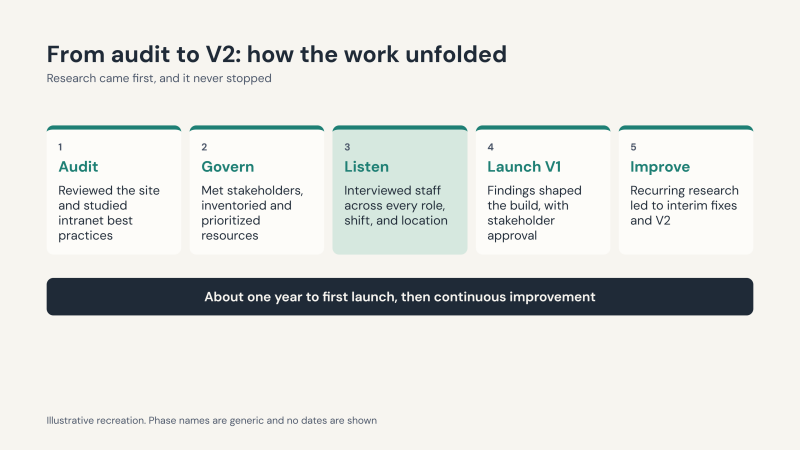
Role: Intranet Content Analyst, later UX Designer | Skills: content audit, governance, staff and stakeholder interviews, information architecture, search and taxonomy, content design | Duration: about one year to first launch, then ongoing improvements and a V2 launch
Summary
Southern New Hampshire Health's intranet had grown without a plan, and only long-time staff could find what they needed. I audited it, built a governance model with key stakeholders, and interviewed about 300 staff across every role, shift, and location. The findings shaped a new intranet that worked for everyone, not just long-time staff. Satisfaction, trust, and usage rose.
The problem
The health system included a Southern NH Medical Center and about 70 provider practices, and its intranet had grown haphazardly. Long-time staff knew where to look. Everyone else struggled. For clinical staff that was a risk: they needed the most current resources quickly, at the point of need.
How might we give every staff member the right resource, in the right format, when they need it?
My role
I was hired as Intranet Content Analyst with one goal: create a new intranet for the entire health system that worked well for staff. I did the research, created the governance model and playbook, and made recommendations. I co-led the research and recommendation to the CIO on which content management system to buy, and then we built the first version with the help of IT server team, an outsourced designer and an engineer. Along the way I discovered UX, which shaped my career.
Process
- Audited the site. I reviewed the existing site and its resources, and studied intranet best practices.
- Built governance and priorities with stakeholders. I met with HR, Legal, IT, and physicians to learn which resources and news were needed and how the site should support the organization’s goals and culture. For each area I listed the resources, who needed them, why, and in what format, then prioritized them. This informed the governance document.
- Planned a representative sample. I asked HR for staff categories: responsibility level, clinical and non-clinical roles, specialties, shifts, and locations. I told the management team about the project and kept leaders informed before and during contact with staff.
- Interviewed about 300 staff over many months. I met representative staff from every category, including every 24/7 shift.
- Synthesized and recommended. The insights shaped V1, reviewed and approved by stakeholders and built with the IT server team, designer, and engineer.
- Kept improving. I attended staff meetings and kept a recurring research cadence to prepare interim fixes and V2.
Highlights
- Homepage. Treated as prime real estate: the organization’s vision and culture, timely news, events, and top resource links, all above the fold.
- IT downtime notices. Static notices full of jargon, with no backup procedures, became a dedicated dynamic feature: plain language, links to backup protocols, common message templates, and assigned IT staff who could update status easily.
- Forms. One searchable, complete resource holding only the most current clinical and non-clinical forms. Retired forms stayed searchable with their updated status and a link to the replacement. As a member of the Document Control Committee, I applied its practices so the intranet always held the newest version, which mattered most for clinical staff.
- Search and information architecture. Search optimization, taxonomy, usability heuristics, and link integrity, monitored regularly.
Impact
- Staff could find what they couldn’t before, including current clinical resources, quickly and easily.
- The intranet worked for everyone, not only long-time staff. I often heard, “I can finally find what I need.”
- Trust, confidence, satisfaction, and usage rose, as shown by surveys, Google Analytics, and staff feedback.
- Downtime information became clear, with backup procedures a click away and real-time updates.
- The CIO funded my first formal UX training.
What I learned
This is where I discovered UX, and I learned several lessons that I have carried forward:
- Plan questions to avoid bias. How I ask matters as much as who and what I ask.
- Listen first, take notes second. I recruited help with note-taking so I could focus on listening.
- Validate feedback before acting. I record what staff tell me, but I act only once it is validated and quantified.