Case Study 3: Reframing a transaction as a partnership: research for a new digital initiative
Closing the project gap: turning checkout from an endpoint into a bridge
Role: Lead Researcher | Skills: generative interviews, recruiting hard-to-reach audiences, adaptive research design, executive readout | Timing: spring 2026, six weeks from first meeting to readout
Summary
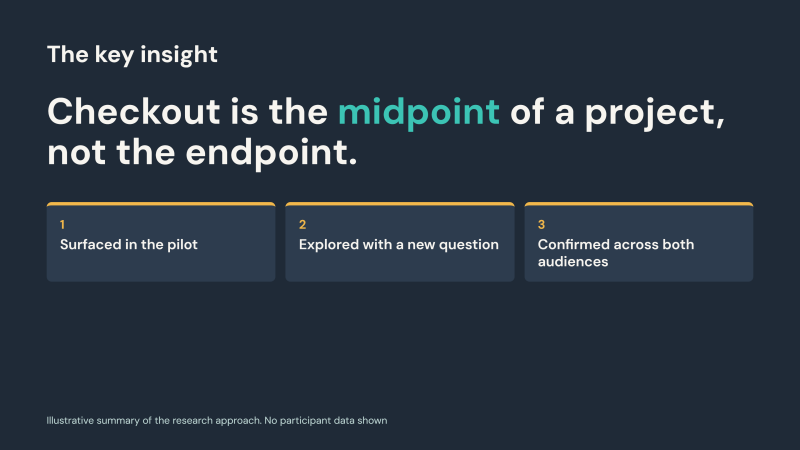
A product leader needed evidence to make the case for a new checkout feature. I led interviews with two audiences, professionals and DIY customers. A pilot interview surfaced an unexpected thread, and I adapted the study to explore it. The result was a “hero” insight: for some customers, checkout is the midpoint of a project, not the end. It supported the business case and pointed to a larger opportunity: a partnership with customers rather than a transaction.
The problem
Customers with projects keep discovering what they need after they place an order, yet checkout treats the order as a transaction. The product leader had an idea and needed to know whether customers wanted it, what triggered the need, and what the experience should be, in time to build a business case.
How might we help customers keep a project moving after they place an order?
My role
I was the lead researcher and did every research step in close collaboration with the product leader: research design, recruiting, interviews, analysis, and readout. The product leader framed the business question. A designer built the prototype, and I presented the findings.
Process
- Designed for the hard-to-reach audience. Professionals are difficult to recruit. I used screener templates I had built and refined, and I added buffer time for no-shows and cancellations.
- Piloted first. I always pilot to catch script flaws and stay open to surprises. This pilot surfaced something new, and with the stakeholder’s agreement I adjusted the script to explore it.
- Ran generative interviews. I interviewed 15 participants per audience - professional and DIY customers, plus 4 associates who partner with professionals.
- Closed with a “wish” question. It was designed around what the pilot surfaced. Both audiences answered in ways that confirmed the hero insight, for different reasons.
- Synthesized by audience. I mapped triggers and friction points for each segment.
What I delivered
- Triggers and friction points for each audience
- Timing recommendations, with different defaults per audience
- A data-backed readout with interview clips, customer voices, and supporting data
- A staged path from a simple feature to proactive, progressively more helpful support
Impact
- The research supported the business case, and the product leader advanced the feature to the next step toward becoming a company priority.
- After the readout, the product team leader described the research as “high quality.”
What I learned
- Recruiting is the plan. Know your audience, build a strong screener, and add buffer time. With a strong screener and a tested script, a last-minute no-show doesn’t threaten the findings.
- Stakeholder collaboration prevents surprises. I shared strategy and results throughout and invited stakeholders to observe sessions, which built confidence in the process.
- A pilot is for learning, not only fixing. In this study the pilot produced a key insight.