Case Study 1: Mapping the Delivery Journey from Both Sides: Customers and Associates
Role: Research Lead, co-leading with a project manager | Skills: field research, contextual inquiry, journey mapping, stakeholder alignment |service blueprinting | Duration: 8 months, including 3 months of fieldwork and shadowing
At a glance: 5 personas · 4 associates shadowed · 4 sites · 8 months
Summary
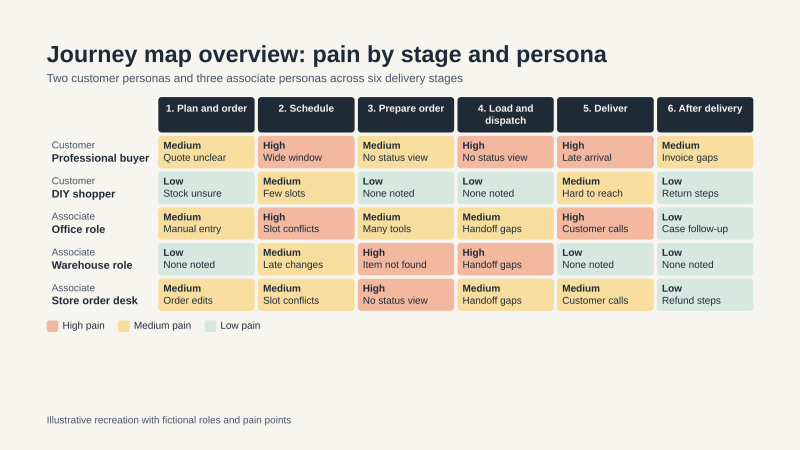
At The Home Depot, information about local delivery was scattered across teams, so no one had a single trusted picture of it. I co-built an end-to-end journey map covering both customers and the associates who serve them, validated through field observation and expert review. We then worked with team leaders to match pain points to existing initiatives and find the gaps. The finished map was posted and the artifact became a standard template for journey mapping.
The Problem
Local delivery was a known pain point for a high-value customer segment and sat inside a high-priority initiative. What the company knew was split across teams, out of date in places, and missing in others. Clarity and visibility into which pain points mattered most was lacking because no one could see the end-to-end journey.
How might we give every team one validated picture of delivery, from the customer’s side and the associates’ side?
My Role
I was assigned as Research Lead for the project’s duration, co-leading with a project manager and reporting to the principal UX lead for deliveries. I planned the research, did the fieldwork, co-built the journey map and a focused readout deck.
Process
- Traced what already existed. I looked for earlier research, worked out who owned it, and validated or removed it. This was harder than expected (see learnings).
- Narrowed the scope. The initial scope had too many personas. We shifted to focus on the two primary customer and three associate personas - those associates having the biggest effect on the journey, front end and back end.
- Went into the field. I shadowed four associates across warehouse and store locations to see the work, tools, and any workarounds first-hand.
- Validated with experts. I worked with researchers who knew different parts of the Pro and DIY delivery journeys to check each persona’s actions and pain points.
- Reviewed with team leaders. Together we matched each pain point to initiatives in place or scheduled, found the gaps, and prioritized them by severity and scope.
What I Delivered
- One validated end-to-end journey map, with the gaps in earlier knowledge filled in
- A view of where initiatives covered pain points and where they didn’t
Impact
- One story replaced scattered information. Every team had the same end-to-end validated view of the journey.
- Leadership could see it. The map was printed and posted in a hallway leaders passed often, making visible a highly prioritized journey.
- It became a model. The map was later used as an example of how to build an end-to-end journey map.
What I Learned
- Start with the key personas, then widen the scope. Focusing on the personas with the most influence sped up the work and surfaced the key insights. Additional persona information followed.
- Finding trustworthy research is part of the job. With no central repository or document control, and teams that had moved often, I confirmed each source was current before I used it.